Abstract
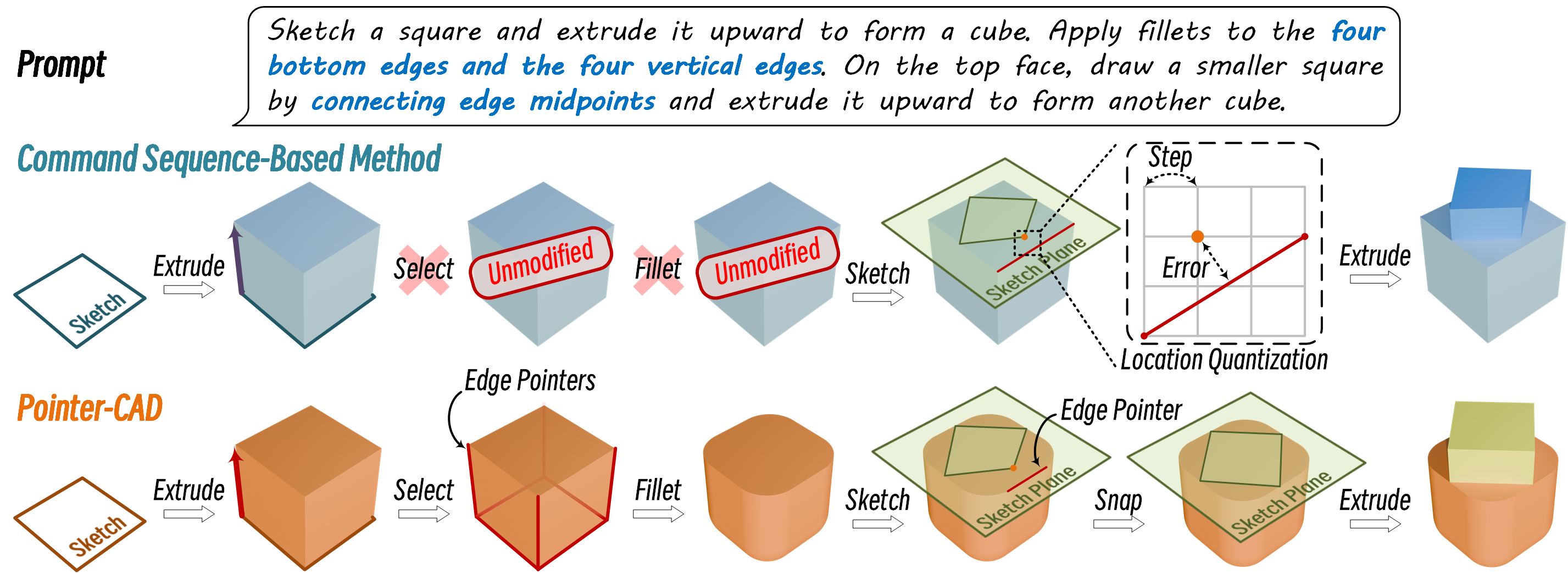
Recent LLM-based CAD generation methods represent models as command sequences, but they struggle to reference geometric entities (e.g., faces or edges), limiting complex edits such as chamfer and fillet and introducing quantization-induced topological errors.
We propose Pointer-CAD, a novel LLM-based framework that introduces a pointer-based command representation to explicitly model geometric relationships in B-rep CAD models. By conditioning each operation on both the textual description and the intermediate geometry, Pointer-CAD enables precise entity selection through pointer prediction, improving editing accuracy while reducing quantization errors.
Contributions
Pointer-based CAD Representation
Pointer-CAD Framework
Generation Comparison
Models with Basic Operations (Sketch & Extrude)
Models with Complex Operations (Fillet & Chamfer)
Generation Showcase
Complex CAD models generated by Pointer-CAD
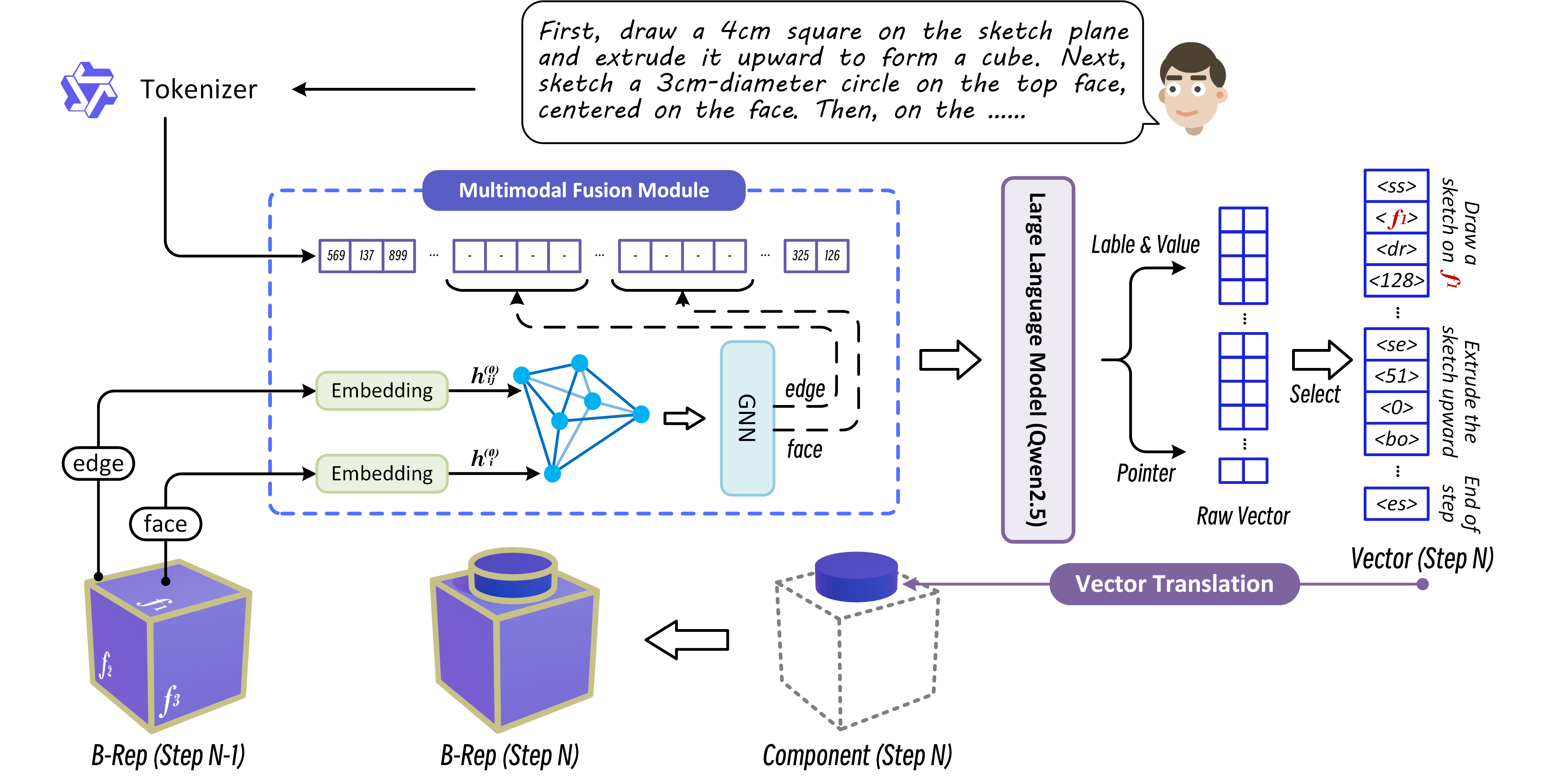
Pointer-CAD generates precise CAD models in a step-by-step procedural manner, where each generation step predicts only one fundamental CAD operation (Sketch, Extrude, Chamfer, or Fillet).
Why step-wise generation?
Unlike previous command-sequence approaches that generate the entire modeling sequence at once, Pointer-CAD decomposes the process into multiple structured steps.
Each step focuses on predicting a single CAD operation, making the generation process more stable, interpretable, and suitable for complex designs.
How Pointer-CAD works
At every generation step, Pointer-CAD relies on three key components:
🔗 Multimodal Fusion Module
Takes the full text prompt together with the current B-rep geometry and fuses these modalities into a unified representation.🧠 Large Language Model (LLM)
Predicts the command sequence for the current CAD operation based on the fused representation.📐 Vector Translation Module
Converts the predicted command sequence into an updated B-rep, which serves as the input for the next step.
Key idea
By conditioning each step on both the text instruction and the intermediate geometry, Pointer-CAD enables accurate geometric reasoning and supports complex CAD operations that are difficult for previous autoregressive approaches.
If you find our work useful, please cite:
@inproceedings{qi2026pointer,
  title={Pointer-cad: Unifying b-rep and command sequences via pointer-based edges \& faces selection},
  author={Qi, Dacheng and Wang, Chenyu and Xu, Jingwei and Chu, Tianzhe and Zhao, Zibo and Liu, Wen and Ding, Wenrui and Ma, Yi and Gao, Shenghua},
  booktitle={Proceedings of the IEEE/CVF Conference on Computer Vision and Pattern Recognition},
  pages={17377--17387},
  year={2026}
}